


Customized Cast Iron Base Platform Supports Non-Standard Size Multi-Hole/Groove Design
Other Products


Industrial Applications of Cast Iron Platforms and Their Stability
I. Basic Construction of Cast Iron Platforms
Cast iron platforms are primarily made from high-strength gray cast iron HT200-300, which undergoes aging treatment and precision planing. This material selection ensures high hardness and wear resistance of the platform, with working surface hardness typically ranging between HB160–210. Some products even meet higher hardness standards. Platforms come in various shapes, including rectangular, circular, T-shaped, etc., to meet the needs of different working scenarios. The surface can be treated with sandblasting, scraping, or precision grinding as required to achieve different accuracy grades, such as Grade 0, Grade 1, Grade 2, Grade 3, etc. High-precision platforms are suitable for measurement and machine tool calibration, while general machining can use platforms with lower accuracy grades.
II. Functions of Cast Iron Platforms
1. Measurement and Reference Plane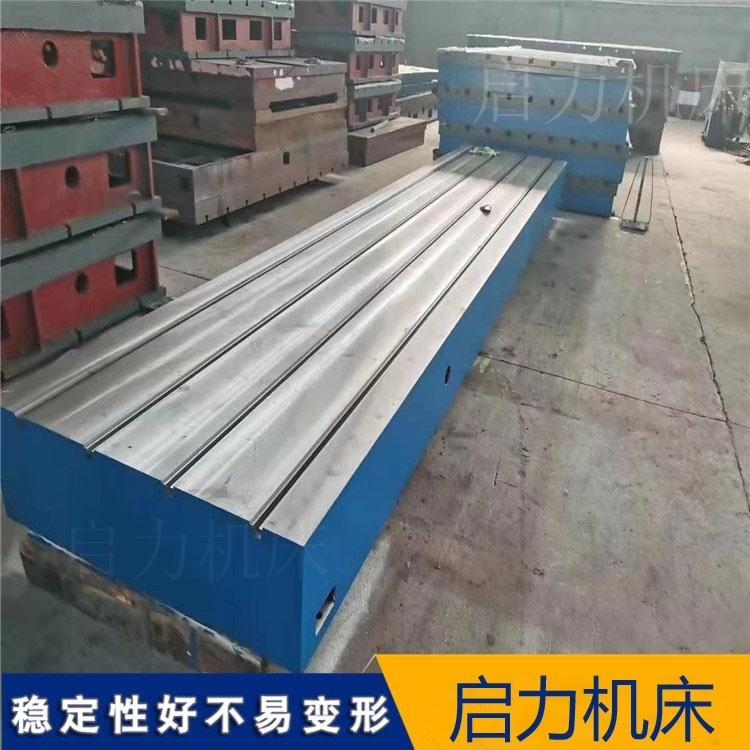

Cast iron platforms serve as reference planes for measurement and are widely used in various inspection tasks. In the mechanical manufacturing process, they act as measurement benchmarks for machine tools, ensuring that the dimensional accuracy and geometric deviations of parts meet design requirements. Additionally, platforms can be used for marking, providing accurate references for subsequent processing and assembly.
2. Key Tool in Mechanical Manufacturing
In the field of mechanical manufacturing, cast iron platforms are indispensable basic tools. Whether producing steel frames for civil air defense door frames and door leaves or assembling double-leaf civil air defense doors, platforms play a crucial role. They support multiple functions such as marking, measurement, riveting, welding, and tooling processes, providing a stable and reliable working platform for mechanical manufacturing.
3. Wide Application Across Multiple Industries
Cast iron platforms are not only used in mechanical manufacturing but are also widely extended to industries such as electronics, instrument production, petrochemicals, mining machinery, construction, machining, automotive manufacturing, and water treatment. In these industries, platforms serve as the foundation for marking, measurement, and tooling processes, facilitating industrial production. Particularly in heavy industry, the use of platforms is widespread, accounting for over 95%.
III. Application Examples of Cast Iron Platforms
Taking automotive manufacturing as an example, cast iron platforms play a key role in the processing of engine blocks. By using high-precision cast iron platforms, automotive manufacturers can ensure consistency in the machining accuracy of engine blocks, thereby improving product quality and production efficiency. Furthermore, in industries such as shipbuilding, electronics, and electrical appliances, platforms also play important roles, providing strong support for product manufacturing.
IV. Precautions for Using Cast Iron Platforms
To ensure the stable performance and longevity of cast iron platforms, the following points should be noted during use:
1. Installation and Debugging
Before using a cast iron platform, installation and debugging are required. Ensure the installation ground is level and free from vibration sources. If necessary, foundation treatment should be carried out to guarantee the platform's stability. Additionally, use tools such as levels to adjust the platform, ensuring all parts are on the same horizontal plane to minimize measurement errors.
Qili Machine Tool, Ms. Xie 13785751790
| Industry Category | Hardware & Tools/Castings/Iron Castings |
|---|---|
| Product Category | |
| Brand: | 泊头启力机床 |
| Spec: | 2000*5000 |
| Manufacturer: | 泊头启力机床 |
| Origin: | 111309 |


